What is a Nikah? The Complete Guide for UK Muslim Couples
The nikah is the Islamic marriage contract, the heart of a Muslim wedding. This guide explains what happens during the ceremony, who needs to be present, and what to expect as a couple in the UK.
Words by PlanMyNikah Team
29 June 2026
4 minute read
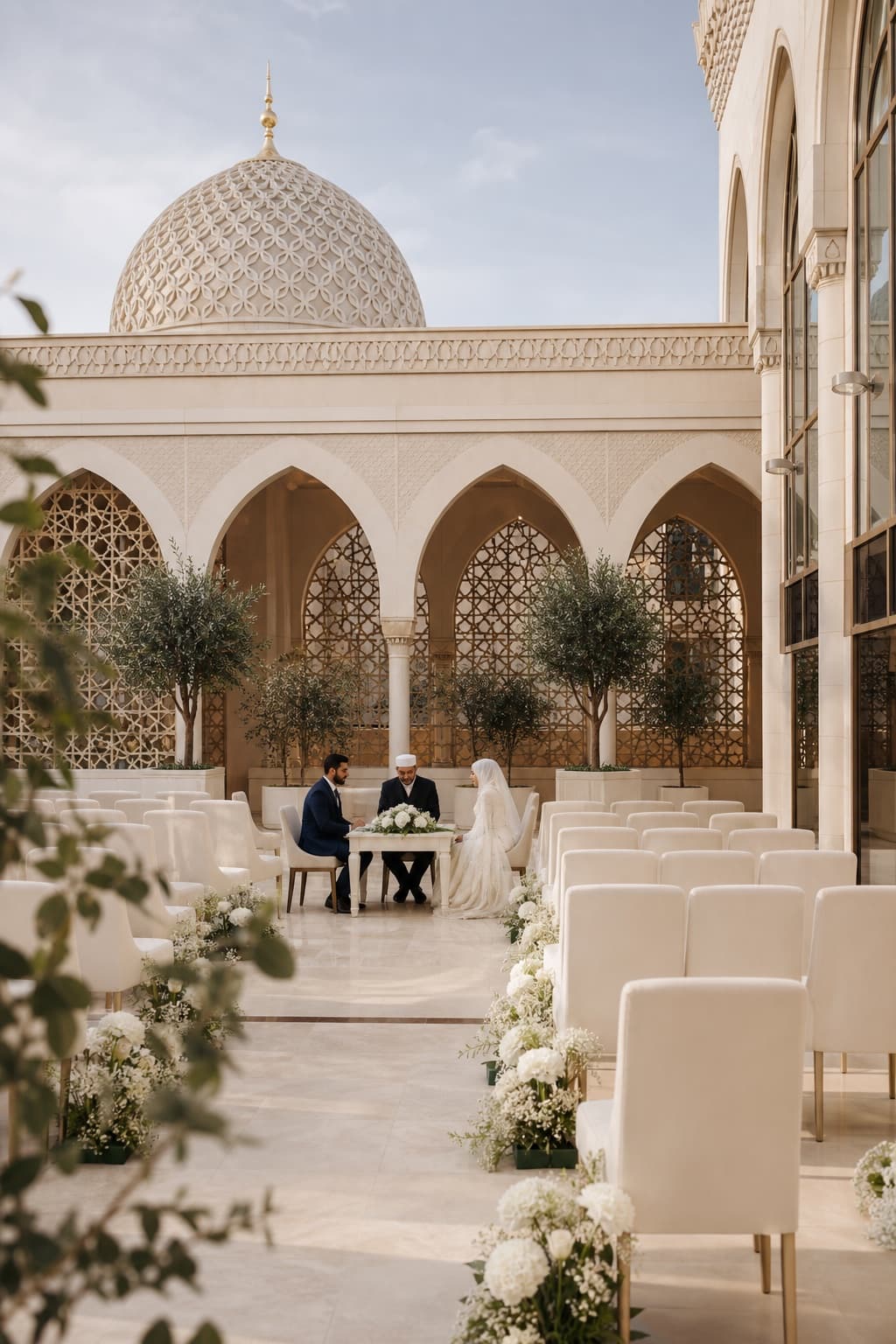
The nikah is the Islamic marriage contract and the most important part of a Muslim wedding. It is a simple, solemn ceremony that marks the moment two people become husband and wife in the eyes of Allah and, when registered correctly, in the eyes of UK law. Here is everything you need to know.
What does nikah mean?
The word nikah comes from the Arabic for marriage. In Islam, marriage is a sacred covenant (mithaq), not merely a social arrangement. The nikah ceremony formalises that covenant through a verbal contract witnessed by others.
What happens during a nikah ceremony?
A nikah has a small number of essential elements:
- The proposal and acceptance (ijab and qabul): The groom (or his representative) proposes and the bride accepts. Both must give free, voluntary consent.
- The mahr: A gift from the groom to the bride, agreed before or at the ceremony. It can be money, property or anything of value. It belongs entirely to the bride.
- Two witnesses: At least two adult Muslim witnesses must be present.
- The wali: The bride's guardian (typically her father or another close male relative) represents her in the contract.
- The imam or officiant: Usually an imam conducts the ceremony and may deliver a short khutbah (sermon), though this is not a religious requirement.
The ceremony itself is often short (sometimes as little as fifteen minutes), though families may surround it with prayers, Quranic recitation and a gathering that lasts much longer.
For a fuller explanation of what can be agreed, when it is due and how to record it clearly, read What is mahr?.
Note
In Islam, a marriage cannot be valid without the bride's free consent. She can also appoint a representative other than a blood relative as her wali if no suitable male guardian is available. Speak to a scholar if this applies to you.
Who must be present at a nikah?
The minimum requirement is the bride, the groom, the wali, and two adult Muslim male witnesses (or the equivalent, as scholars differ on witness requirements, so follow your madhab or ask your imam). Most nikahs in the UK also have an imam present.
Family and guests are not a religious requirement, though most couples celebrate with loved ones.
Is a nikah legally recognised in the UK?
A nikah performed in a mosque or Islamic ceremony alone is not automatically legally recognised in the UK. To be legally married in England, Wales or Scotland, you must also complete a civil marriage ceremony (at a register office or an approved venue).
Many couples hold their civil registration the same day or shortly before or after the nikah. Some mosques and Islamic centres are licensed to perform legally recognised marriages. Ask yours before assuming.
Important
Without a legal registration, a nikah-only marriage has no legal standing in English law. This affects inheritance rights, pension rights, and next-of-kin status. Always register your marriage.
What is the difference between a nikah and a wedding?
The nikah is the Islamic contract, the religious marriage. A Muslim wedding (shadi) typically refers to the full celebration, which often includes a mehndi (henna night), the barat (groom's procession and reception), and the walima (post-marriage feast). The nikah is the legal and religious core around which those celebrations are arranged.
How do you plan a nikah in the UK?
Planning a nikah involves booking an imam, confirming the date and venue, arranging the mahr, and ensuring two witnesses are lined up. You will also need to decide whether to hold the civil registration on the same day.
Use the free Wedding Checklist on PlanMyNikah to track every task from twelve months out to the morning of the ceremony, and the Budget Planner to manage costs across all your events.
The practical edit
Frequently asked questions
Does the bride have to be present at the nikah?
Yes, and she must give free, voluntary consent. A nikah conducted without the bride's consent is not valid in Islam.
Can a nikah be held at home?
Yes. A nikah does not have to take place in a mosque. It can be held at home, in a hall or in any space agreed by both parties. If you want it to be legally recognised in the UK, however, it must be conducted by a registrar or in a licensed venue.
How much does a nikah cost in the UK?
The cost of an imam's fee varies but is typically £100–£300. The mahr is agreed between the couple. If you want a separate civil ceremony it will cost from around £50 for a register office ceremony. Browse venues on PlanMyNikah to compare spaces that can host both events.
Do you need a specific type of imam to conduct a nikah?
No specific qualification is required from an Islamic standpoint, though most families choose an imam from a local mosque they trust. For a legally recognised ceremony in England and Wales, the officiant must be an authorised person registered with the General Register Office.
The letter from the editor
Wedding planning tips, straight to your inbox
Nikah checklists, budget advice and practical ideas, about twice a month. No spam.
Continue the edition
Related reading
Ummi Chowdhury: Bridal Artistry with an Editorial Eye
Meet Ummi Chowdhury, the London and Essex bridal hair and makeup artist with a London Runway editorial credit, a dedicated travelling team and bookings available across the UK and internationally.
PlanMyNikah vs Hitched for Muslim Weddings
An honest comparison of PlanMyNikah and Hitched for UK Muslim couples, covering vendor discovery, planning tools, faith-specific needs and which platform suits whom.
Questions to Ask a Muslim Wedding Venue Before Booking
Take this checklist to every venue viewing: halal catering, prayer space, segregation layouts, capacity, hidden costs, access, timings and contract terms.