How to choose the perfect nikah venue
How to choose a nikah venue in the UK: venue types, legal registration, capacity, in-house catering rules, access and the contract terms to read before a deposit.
Words by Ilyas Amar
8 June 2026
8 minute read
Updated 21 October 2026
Sources, estimates and corrections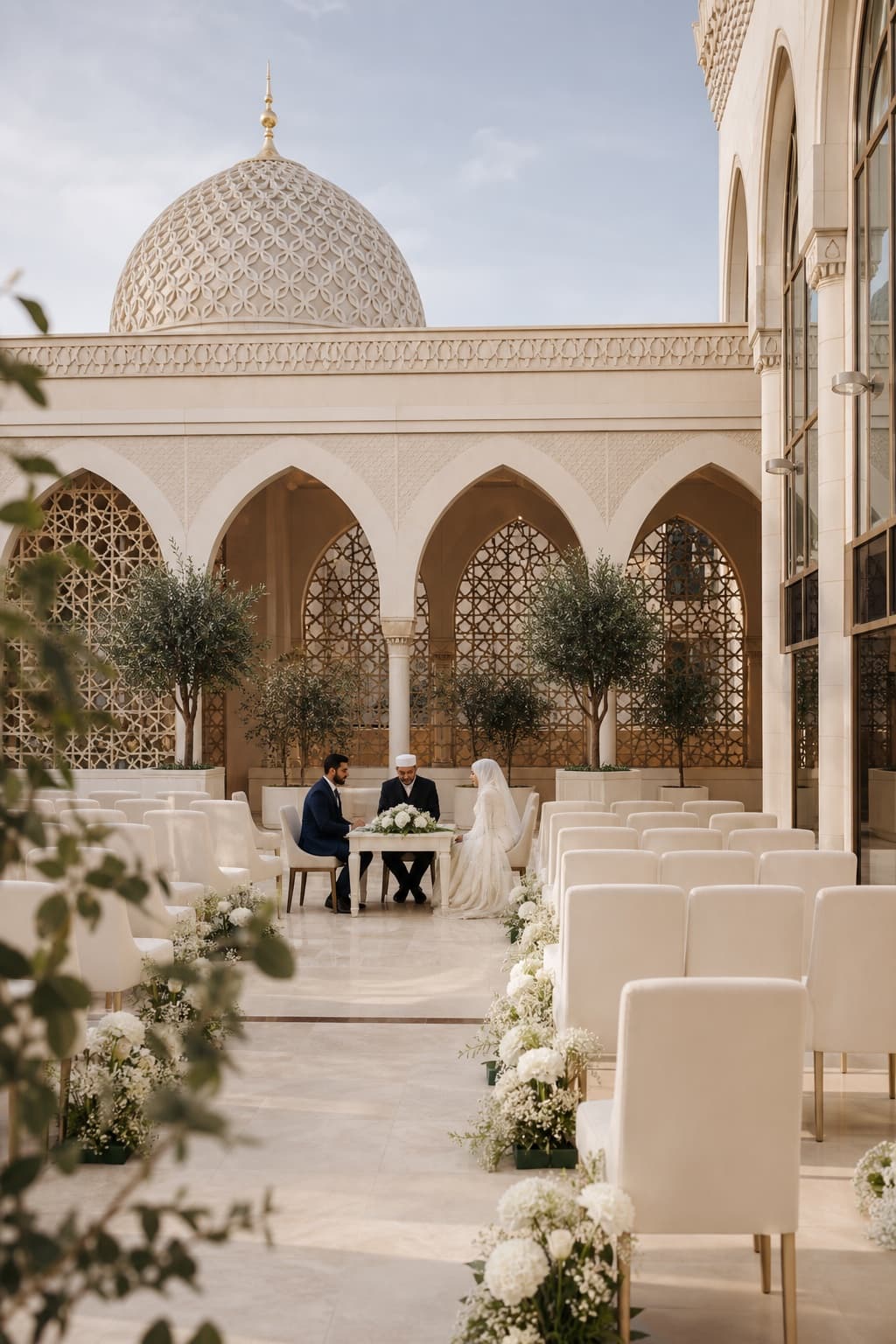
To choose a nikah venue, start with your guest numbers and the legal route you need, then compare venue types, check the catering rules and capacity, and read the contract before you pay a deposit. The venue sets the tone and the budget for everything else, and GOV.UK says you must decide it before you give notice of marriage in England and Wales. For the full script to use at viewings, read our questions to ask a Muslim wedding venue.
How do you choose a nikah venue?
Choose in this order: guest numbers, the legal route you need, venue type, then catering rules, access and price. Build a rough guest list first and shortlist venues that comfortably fit it. Visit at the time of day your event will run, and read the contract before you commit to anything.
Tip
Visit at the time of day your event will run. Light, parking and atmosphere can be completely different at an evening walima than at a Tuesday afternoon viewing.
A room that is too big feels empty and one that is too small feels stressful, so aim for a space that is comfortable at your expected number, with a little room to breathe.
Which type of venue suits a nikah?
Each venue type suits a different nikah, and each raises different legal and practical questions. A mosque or registered religious building suits a traditional nikah, a hall or hotel suits a nikah combined with a reception, and a home suits a small private ceremony. The table shows what to check for each.
| Venue type | Often suits | Legal check | Watch for |
|---|---|---|---|
| Mosque or other registered religious building | A traditional nikah led by an imam | Ask if it is registered for marriages and has an authorised person. If not, a registrar must attend | Capacity, prayer times, rules on photography and food |
| Banqueting hall or hotel | A nikah combined with the reception | Ask whether it is approved for civil marriages and whether a registrar is included | In-house catering rules, alcohol in shared areas, overtime |
| Community hall or restaurant room | A smaller nikah followed by a meal | Ask the same approved-premises question | Kitchen access, step-free access, finish times |
| Home | A small, private nikah | A private home is not a registered building, so a nikah there is usually a religious marriage only | Space, parking, prayer space and neighbours |
Does the venue have to be registered for a legally recognised nikah?
In England and Wales, a religious wedding can take place at any registered religious building, and an authorised person such as a religious minister must attend. If the venue has none, you need to book a registrar. GOV.UK also says you must decide the venue before you give notice of marriage.
GOV.UK says you must give notice at least 29 days before your ceremony, and hold the ceremony within 12 months of giving notice. Civil ceremonies can be held at a register office or at a venue approved by the local council. If a registrar must attend a religious venue that has no authorised person, GOV.UK gives the fee as £114.50.
Read Is a nikah legally recognised in the UK? for the rules in each nation. A nikah that does not meet the civil requirements is usually a religious marriage only. This is general information, not legal advice.
How many guests can a venue really hold?
Published capacity can assume a layout with no room for a stage, a prayer area, a buffet, buggy parking or wide aisles. Ask for the capacity using your chosen table shape and every feature you plan to include, and ask what happens if numbers rise or fall before the final deadline.
Build a rough guest list first using the Guest List. GOV.UK says the responsible person for premises the public can access must carry out a fire risk assessment (fire safety responsibilities), so ask the venue how your layout fits it. If you plan separate sections, read our guide to planning a segregated wedding.
Can you bring your own halal caterer to a venue?
Sometimes. Some venues require in-house catering, so confirm before you sign anything. Ask whether catering is in-house, from an approved list or open, what the halal policy is, and what extra fees apply to an outside caterer. "Halal option available" does not mean the whole kitchen or menu meets your expectations.
Important
In-house catering rules are the most common nasty surprise. If you have a caterer in mind, confirm you are allowed to bring them before you sign anything.
If the venue supplies the food, ask for its halal policy and the evidence for the meat or kitchen arrangement you need. The Halal Monitoring Committee publishes directories of HMC certified caterers, and the Food Standards Agency says businesses must supply allergen information for every non-prepacked item containing any of the 14 allergens (FSA allergen guidance). Our halal wedding catering guide covers what to ask.
What facilities does a nikah venue need?
Make a short list of what your families need, then confirm each item in writing: prayer and wudu space, separate seating if you want it, a suitable place for the nikah, parking, step-free access and any rules on bringing your own caterer. The table matches each need to the listing detail you can filter for on PlanMyNikah.
| What you need | Venue search filter | Confirm with the venue |
|---|---|---|
| Prayer space | Prayer space available | Where it is, how many it holds and the wudu facilities |
| Separate seating | Segregated seating | The layout, entrances and sightlines |
| A place for the nikah | Nikah ceremony available | Seating, a stage or table, sound and timing |
| Your own halal caterer | External catering allowed | Kitchen access and any extra fees |
| Step-free access | Disability access | Routes to every room and the toilets |
| Parking | Parking available | Spaces for your guest numbers |
| A civil ceremony | Civil ceremony available | Whether the premises are approved and who books the registrar |
These are listing details, not guarantees. PlanMyNikah's How we verify page says that segregated seating, prayer facilities, nikah space and external catering are self-declared by the vendor, so confirm every one directly with the venue. GOV.UK says service providers must think ahead about barriers for disabled people, so raise access early (Equality Act guidance).
What should you check in the venue contract?
Check the deposit and what it reserves, the cancellation terms, overtime charges, what is included and the deadline for final numbers before you commit. Treat anything important that is not in the written contract as unconfirmed. Knowing the rules upfront keeps a happy booking from becoming a stressful one.
In 2016 the Competition and Markets Authority advised wedding and event venues that a deposit is fair when it is just to reserve the service, that venues should not require unjustifiable non-refundable deposits, and that unfair terms are not legally binding even when signed (CMA, March 2016). Only a court can decide whether a term is unfair. Citizens Advice says you may have a contract even if nothing is in writing, once you have accepted a quote or paid a deposit (Citizens Advice).
When should you book a nikah venue?
Start your venue search 9 to 12 months before the nikah if you can. That is our suggested order, not a rule. Ask each venue which dates are still free, because popular dates may go first, and confirm the venue before you give notice of marriage, since GOV.UK says it must be decided first.
If your date is closer, shortlist two or three venues that can fit your numbers and ask each for a written quote.
What should you take to a venue viewing?
Take this checklist and your guest list, and write the answers down. Then browse UK wedding venues on PlanMyNikah to compare options, and save your favourites to your shortlist. Use the questions to ask a Muslim wedding venue so the practical and faith-conscious details are recorded before you pay a deposit.
- Confirm capacity for your real guest number and layout
- Ask about separate seating options, if you want them
- Clarify catering rules (in-house or an outside halal caterer)
- Check what is included and what costs extra
- Ask about prayer space, wudu facilities and step-free access
- Read deposit, cancellation and overtime terms
Which sources does this guide use?
The legal steps come from GOV.UK. The deposit points come from the CMA and Citizens Advice, the halal and allergen points from the Halal Monitoring Committee and the Food Standards Agency, and the facility filters from the current PlanMyNikah venue search. The booking order is our suggestion, not a rule.
- GOV.UK: Plan your ceremony
- GOV.UK: Give notice of marriage
- GOV.UK: Workplace fire safety, your responsibilities
- GOV.UK: Disability, quick start guide for service providers
- GOV.UK, CMA: Wedding venues advised to play fair (2016)
- Citizens Advice: Cancelling a service you've arranged
- Halal Monitoring Committee: About us
- FSA: Allergen guidance for food businesses (GOV.UK)
The practical edit
Frequently asked questions
Can I bring my own halal caterer to a venue?
Sometimes. Some venues require in-house catering, so always confirm before booking. It is one of the most important questions to ask early, and the answer should be in your written contract.
How do I know a venue suits a Muslim wedding?
Ask about segregation options, prayer space and catering rules. On PlanMyNikah you can filter venue search by listing details such as segregated seating and prayer space, but these are largely declared by the venue, so confirm each one in writing.
How far ahead should I book a venue?
We suggest starting 9 to 12 months before your nikah if you can. Ask each venue which dates are free and what its terms are, and decide the venue before you give notice of marriage if you want a legal marriage.
Does my nikah venue need to be registered?
For a legal marriage in England and Wales, a religious ceremony must take place in a registered religious building with an authorised person or a registrar present, or you can hold a separate civil ceremony. Ask the venue whether it is registered. This is not legal advice.
The letter from the editor
Wedding planning tips, straight to your inbox
Nikah checklists, budget advice and practical ideas, about twice a month. No spam.
Continue the edition
Related reading
Ummi Chowdhury: Bridal Artistry with an Editorial Eye
Meet Ummi Chowdhury, the London and Essex bridal hair and makeup artist with a London Runway editorial credit, a dedicated travelling team and bookings available across the UK and internationally.
PlanMyNikah vs Hitched for Muslim Weddings
A dated, fair comparison of PlanMyNikah and Hitched for UK Muslim couples: vendor directory scale, free planning tools, faith-specific details and which suits whom.
Questions to Ask a Muslim Wedding Venue Before Booking
Take this checklist to every venue viewing: halal catering, prayer space, segregation layouts, capacity, hidden costs, access, timings and contract terms.