The complete guide to halal wedding catering in the UK
How to choose halal wedding catering in the UK: what certification means, buffet versus plated service, allergens, costs, tastings and what to get in writing.
Words by Ilyas Amar
9 June 2026
9 minute read
Updated 21 October 2026
Sources, estimates and corrections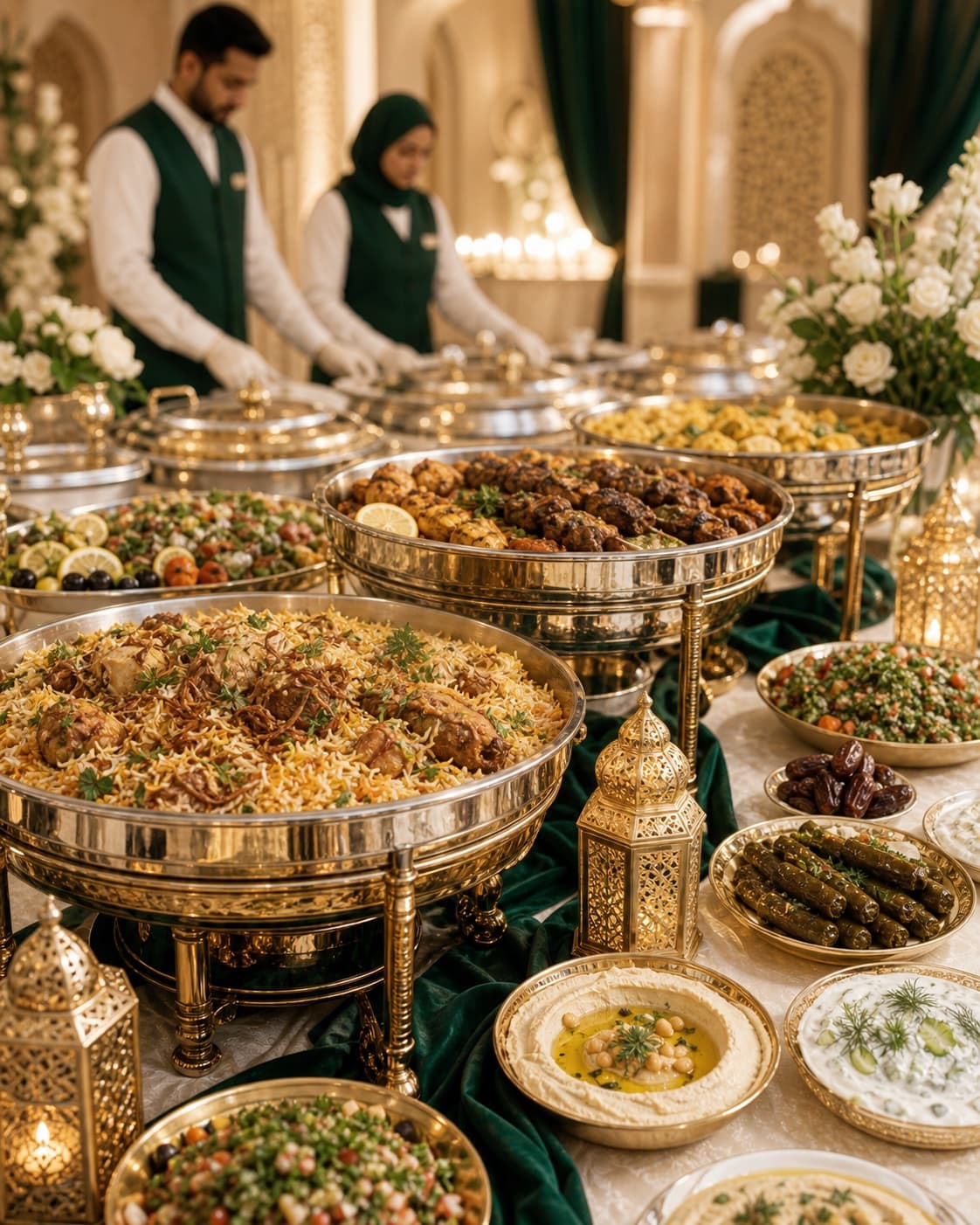
Catering is one of the biggest lines in a Muslim wedding budget and the part guests remember longest. A good halal caterer can show where the meat comes from, tell you which allergens are in every dish and put the whole arrangement in writing. This guide explains how to choose one.
How do you choose a halal wedding caterer in the UK?
Shortlist caterers who can serve your guest count, ask each one to show current halal evidence, request the same written quote from every caterer and book a tasting before paying a deposit. Then confirm allergen handling, service style and timings in writing. A confident caterer will answer all of this without hesitation.
- Fix the guest count and the event. Catering for a walima of 250 is a different job from a nikah lunch for 60. Your Guest List gives you event-by-event numbers.
- Shortlist and send one brief. Browse halal caterers and send each the same date, venue, guest count, service style and halal requirements.
- Ask for halal evidence. See the section below on what certification means.
- Book a tasting. A menu reads well on paper, but the tasting shows portion sizes, spice levels and how the team handles your questions.
- Get everything in writing. Menu, price, timings, halal evidence and allergen arrangements belong in the quote or contract.
What does halal certification mean for a caterer?
Certification means an independent body has assessed the caterer or its meat supply against that body's own standard. The Halal Monitoring Committee (HMC), for example, describes itself as an independent, not-for-profit charity that monitors, inspects and certifies halal products. "Halal" on a menu is only a claim. A current certificate is evidence.
Important
"Halal" on a menu isn't the same as certified. Ask which supplier the meat comes from, ask to see the current certificate and check that it covers the specific meats on your menu.
Certifiers do not all apply the same standard. The Food Standards Agency says most halal meat comes from animals that are stunned before slaughter, and that there is no legal requirement to label meat by slaughter method (see its food fact check on slaughterhouses). So the word "halal" alone does not tell you which method was used. Families hold different views on this, and practice varies, so ask your imam which standard you want and then ask the caterer which one they follow.
| What you are shown | What it tells you | What to ask next |
|---|---|---|
| "Halal" on the menu or website | The caterer's own claim | Who supplies your meat, and what do they certify? |
| A supplier invoice or letter naming the meat supplier | Where the meat came from for a recent order | Is that supplier certified, and by which body? |
| A current certificate from a certification body | A body has assessed the business or supplier for the dates shown | What does it cover (kitchen, meat, particular products) and when does it expire? |
| A listing in a certifier's public directory | The business appears on that body's own list | Does the listing match the certificate you have seen? |
HMC publishes a searchable directory of certified shops that includes caterers and dessert shops, which is a quick way to cross-check a claim. It is one certifier among several, so a caterer certified by another body is not automatically a poor choice. Ask for that body's certificate and check it the same way.
PlanMyNikah does not issue halal certification. A team member reviews every listing before it goes live, and halal evidence is checked in a separate review from listing approval and from the Verified badge. A listing can be live without a halal badge, and self-declared features are not independently verified. Read How We Verify and confirm your own requirements directly with the caterer before booking.
Buffet, plated or sharing platters: which service style suits your wedding?
A buffet suits large guest lists and mixed tastes, plated service feels formal but needs more staff and a tighter timeline, and sharing platters feel generous but need table space. Match the style to the room, the running order and the guest count, not only to the price. The table below is editorial guidance, not survey data.
| Style | Works best for | Watch out for | Allergen point |
|---|---|---|---|
| Buffet | Large walimas and varied family tastes | Queues, running out of popular dishes, unlabelled dishes | Allergen information is needed for each dish separately |
| Plated meal | Formal, seated events | Accurate dietary notes for every seat, extra staff, time between courses | Pass each guest's requirements to the caterer by name |
| Family-style sharing | Table-based meals and smaller gatherings | Table space, portions, dishes being passed to the wrong guest | Keep allergy-safe dishes separate from shared platters |
| Live stations | Mehndi nights and cocktail-style receptions | Power, ventilation, water and queue space | Ask for separate utensils and clear labels |
Tip
A plated meal in a venue with a tight turnaround can stall the whole evening. Check the running order with the venue before you choose a style.
How do you manage allergens and dietary needs at a wedding?
Collect allergies and dietary needs with each RSVP, send the totals to your caterer in writing and ask how they will prevent cross-contact. Food businesses must give allergen information for the 14 listed allergens, and at a buffet that means for each dish separately. Halal certification says nothing about allergens.
The Food Standards Agency lists the 14 allergens as celery, cereals containing gluten, crustaceans, eggs, fish, lupin, milk, molluscs, mustard, peanuts, sesame, soybeans, sulphur dioxide and sulphites, and tree nuts. Its allergen guidance for food businesses says businesses must provide allergen information for every non-prepacked item, either in writing or verbally with a visible written notice, and that written information supported by a conversation works best.
For a buffet, the same guidance says information must be provided for each food item separately rather than for the buffet as a whole. Ask your caterer to label every dish or to name the person guests should ask, and share your guests' needs well before the day. Record them in your Guest List as RSVPs arrive instead of relying on memory.
How much does halal wedding catering cost?
On PlanMyNikah's planning range of £30 to £80 per guest, 100 guests comes to about £3,000 to £8,000 and 200 guests to about £6,000 to £16,000. This is arithmetic on our own estimate, not survey data or a quote. Menu, region and venue change the price, so collect at least three written quotes.
| Guests | Catering at £30 to £80 per guest (PlanMyNikah estimate) |
|---|---|
| 50 | £1,500 to £4,000 |
| 100 | £3,000 to £8,000 |
| 150 | £4,500 to £12,000 |
| 200 | £6,000 to £16,000 |
| 250 | £7,500 to £20,000 |
The Budget Planner's per-head tip suggests allowing £40 to £70 for halal catering, which sits inside this range. The Muslim wedding cost guide shows how the range fits into each event's budget and explains how our estimates were built. Ask every caterer what the per-head price includes: staff, crockery, serving equipment, clearing, VAT and any service charge.
What should you ask at a tasting?
Treat the tasting as a working meeting, not a social one. Bring your draft schedule and guest numbers, and ask the caterer to explain how the food moves from kitchen to guest. Decide who will taste for you, and write down what you agree rather than relying on memory.
- Are portion sizes, spice and salt levels right for your guest mix?
- How do the starters and mains hold up during service?
- Is there a complete vegetarian main, not just side dishes?
- Which allergens are in each dish, and how is cross-contact prevented?
- Which dishes can be adjusted without losing their character?
- What staff, equipment and clearing are included?
- When must the final menu and numbers be confirmed?
Catering checklist
- Confirm current halal evidence and what it covers
- Choose your style of service (buffet, sharing or plated)
- Book a tasting before you commit
- Record guest dietary needs in your Guest List
- Get the quote and everything included in writing
What should the quote and contract say?
Get the menu, guest numbers, price per head, service style, staffing, equipment, timings, halal evidence, allergen arrangements and payment schedule in writing. Under UK consumer law, what a trader says or writes about a service can become part of your contract, so written promises matter more than verbal reassurance.
Section 50 of the Consumer Rights Act 2015 treats information a trader gives you about the service as part of the contract if you take it into account when deciding to book. Section 49 adds that every contract to supply a service includes a term that the trader must perform it with reasonable care and skill. This is general information, not legal advice.
How do you check a caterer's hygiene rating and registration?
Food businesses, including home-based ones, register with their local authority, and you can look up any caterer on the Food Standards Agency's rating site by name or postcode. The rating reflects food hygiene, not food quality, so use it alongside a tasting rather than instead of one.
GOV.UK explains that you need to register a food business with your local authority if you sell, cook, store, handle, prepare or distribute food, including when you trade from home. The Food Hygiene Rating Scheme lets you search by business name, street, town or postcode, and says the rating is not a guide to food quality. If a rating looks out of date, contact the local authority listed on the site.
You can compare halal caterers across the UK on PlanMyNikah and send enquiries directly from each listing.
Which sources does this guide use?
This guide relies on the Food Standards Agency and GOV.UK for allergen, labelling and registration rules, legislation.gov.uk for consumer law, and the Halal Monitoring Committee for what a halal certifier does. Service-style advice is editorial. Prices are PlanMyNikah planning estimates, not quotes. Checked 21 October 2026.
- Halal Monitoring Committee: About us and its certified shops directory for what a certifier says it does and how to cross-check a claim.
- Food Standards Agency: food fact check on animal welfare in abattoirs and slaughterhouses (3 June 2026) for stunning and slaughter-method labelling.
- Allergen guidance for food businesses (GOV.UK, Food Standards Agency) for the 14 allergens and buffet rules.
- Register a food business (GOV.UK) and the Food Hygiene Rating Scheme for registration and ratings.
- Consumer Rights Act 2015, sections 49 and 50 for services and what you are told becoming part of the contract.
The practical edit
Frequently asked questions
How do I check a caterer is genuinely halal?
Ask for the current certificate from a certification body and check that it covers the meats on your menu and has not expired. You can cross-check against the certifier's public directory, such as the Halal Monitoring Committee's list of certified shops. Practice varies between certifiers, so ask which standard they follow.
Buffet or plated for a large walima?
For 250 or more guests a buffet usually keeps service moving, while a plated meal feels more formal but needs more staff and a venue with time in the schedule. Confirm the running order with the venue and ask the caterer how queues and replenishment will be managed.
How do I manage dietary requirements across so many guests?
Record needs in your Guest List as RSVPs come in, then send the totals to your caterer in writing. Ask for allergen information for each dish and name one person guests can ask on the day. This is far safer than relying on memory.
Does halal certification mean the food is safe for allergies?
No. Halal certification and allergen safety answer different questions. A halal dish can still contain any of the 14 allergens. Give the caterer your guests' allergy details in writing and ask how they separate ingredients, utensils and preparation areas.
Do wedding caterers have to be registered?
Food businesses must register with their local authority, including those run from home, according to GOV.UK. You can check a caterer's food hygiene rating on the Food Standards Agency's rating site. The rating reflects hygiene standards, not food quality, so still book a tasting.
The letter from the editor
Wedding planning tips, straight to your inbox
Nikah checklists, budget advice and practical ideas, about twice a month. No spam.
Continue the edition
Related reading
Ummi Chowdhury: Bridal Artistry with an Editorial Eye
Meet Ummi Chowdhury, the London and Essex bridal hair and makeup artist with a London Runway editorial credit, a dedicated travelling team and bookings available across the UK and internationally.
PlanMyNikah vs Hitched for Muslim Weddings
A dated, fair comparison of PlanMyNikah and Hitched for UK Muslim couples: vendor directory scale, free planning tools, faith-specific details and which suits whom.
Questions to Ask a Muslim Wedding Venue Before Booking
Take this checklist to every venue viewing: halal catering, prayer space, segregation layouts, capacity, hidden costs, access, timings and contract terms.