Muslim Wedding Invitation Wording for Your Nikah, Mehndi, Barat and Walima
Practical Muslim wedding invitation wording for UK couples: what to include, how to separate nikah and walima details, and how to make RSVPs clear.
Words by PlanMyNikah Team
7 September 2026
8 minute read
Updated 17 September 2026
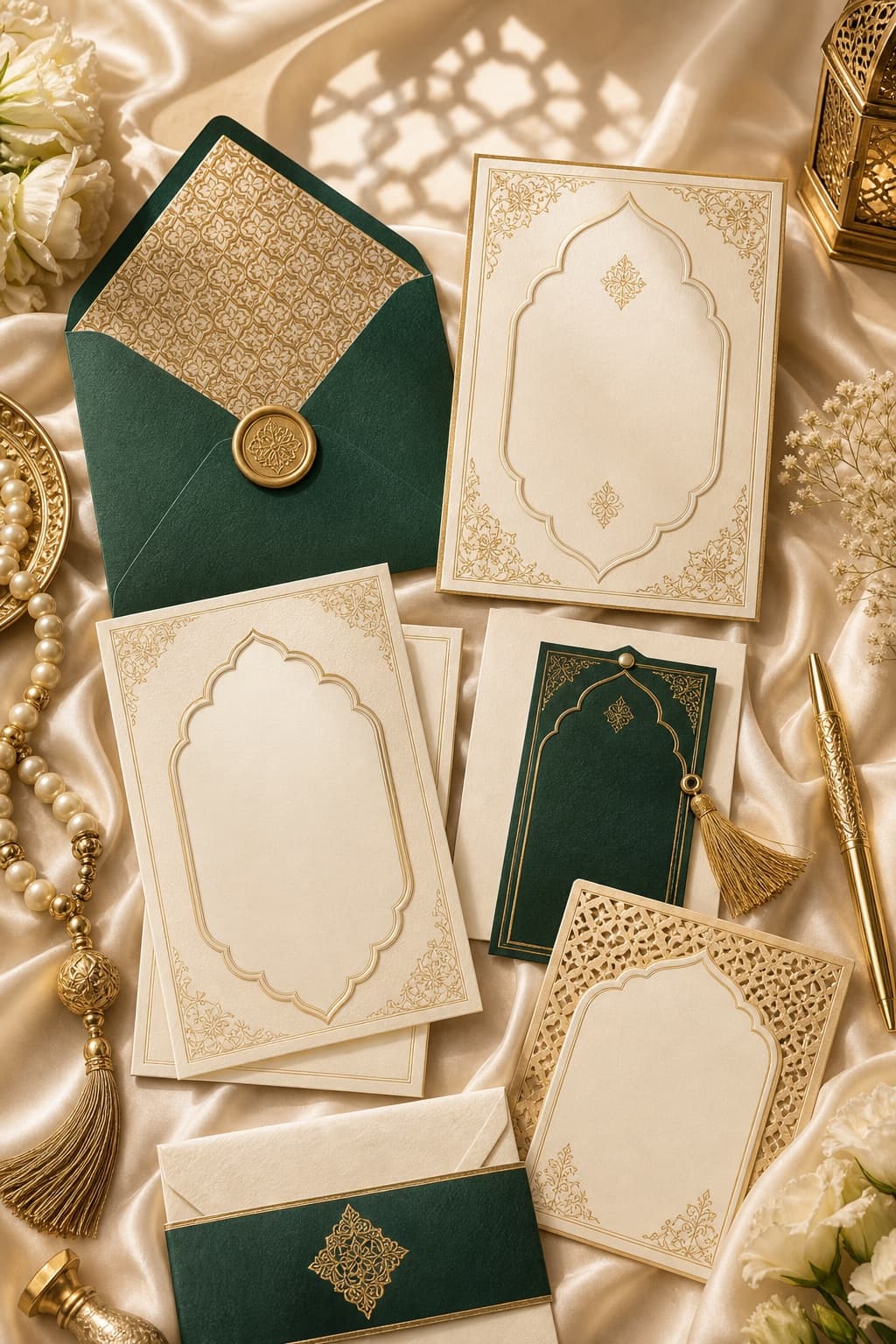
Your invitation has one important job: make it obvious what each guest is invited to, when they should arrive and where they need to go. For a Muslim wedding in the UK, that may mean explaining a nikah, mehndi, barat and walima across different days, venues or guest lists.
Good Muslim wedding invitation wording is less about sounding grand and more about making the right details easy to understand. There is no single template every family has to use. Some couples keep the wording formal; others write in their own voice. What matters is that the invitation is warm, accurate and specific. If a religious or legal detail is personal to your family, confirm it with your imam, venue or register office rather than relying on a copied line from the internet.
If you are still deciding how the events fit together, the Nikah vs Walima guide can help.
Start with the guest list, not the design
Before choosing paper, fonts or a colour palette, make a small event grid. Write down which guests are invited to each part of the celebration:
- Nikah: who is witnessing the marriage contract, and where?
- Mehndi: is it for both families, women only, close friends, or a wider group?
- Barat: who is expected to attend the procession or arrival?
- Walima: is this the main reception, and is the guest list different from the nikah?
A guest may be invited to the walima but not the intimate nikah. Another may be invited to the mehndi but not the barat. Clear wording prevents the awkward assumptions that create last-minute questions.
The essential details every invitation needs
Whether you are sending a printed card, a WhatsApp message or a digital invitation, include the same core information.
2. What the event is
Say “nikah”, “mehndi”, “barat” or “walima” plainly. If you are inviting someone to a reception celebrating the marriage, say that. Avoid using only “wedding” when the day contains several events.
3. When it starts
Give the day, date, year and arrival time. If the nikah begins at 2pm but guests should arrive at 1:30pm, show both times. For a barat or entrance, say whether the time is approximate.
4. Where it is
Include the venue name, full address and postcode. If the nikah and walima are at different places, give each location its own line. Add a map or directions link to your wedding website rather than trying to fit every travel detail on the card.
5. How to RSVP
Name the person or system receiving replies, give a deadline and explain what guests need to confirm. A QR code can be useful, but include a short alternative for relatives who prefer to reply by phone or WhatsApp.
Muslim wedding invitation wording templates
Use these examples as starting points, then replace every bracketed detail and adjust the tone to sound like your family.
Traditional nikah invitation wording
Bismillah ir-Rahman ir-Raheem
Together with their families, [Name] and [Name] request the pleasure of your company at their nikah.
[Day], [date] [month] [year]
Guests arrive at [time]
Nikah begins at [time]
[Mosque or venue name]
[Full address and postcode]Please RSVP to [name] by [date]
[Phone number or reply link]
“Bismillah ir-Rahman ir-Raheem” is an optional opening, not a requirement for a valid invitation. If you include Arabic text or transliteration, ask a trusted reader to check it before printing.
Couple-hosted wording
By the grace of Allah,
[Name] and [Name] invite you to witness their nikah and celebrate with them.
[Day], [date] [month] [year] at [time]
[Venue name and full address]Dinner will follow at [time].
Please reply by [date] at [link or contact details].
Separate nikah and walima wording
When the two events have different guest lists, make that difference visible rather than hoping people notice an insert.
[Family name]
warmly invite you to the walima celebrating the marriage of [Name] and [Name].[Day], [date] [month] [year]
[Arrival time]
[Venue name]
[Full address]This invitation is for the walima reception.
Please RSVP for [number of guests] by [date].
That final line can feel direct, but direct is kinder than leaving guests to guess. You can soften it with “We look forward to celebrating with you at the walima” while keeping the event boundary clear.
Combined nikah and walima wording
If both events are on the same day, list them as separate moments:
Together with their families, [Name] and [Name] invite you to their nikah and walima.
Nikah: [time], [venue and address]
Walima: [time], [venue and address]Please arrive by [time].
Kindly RSVP for the nikah, walima or both by [date].
Mehndi, women-only or separate-space wording
Use the most accurate description for your event. For example:
You are warmly invited to [Name]’s women-only mehndi evening.
[Day], [date] at [time]
[Venue and address]Henna will be available from [time].
Please RSVP by [date].
For a celebration with separate spaces, say so plainly:
The celebration will have separate spaces for women and men. Please follow the signs on arrival. If you need an accessibility arrangement or have a question about the layout, contact [name] before the day.
Only mention women-only attendance, separate seating or other arrangements when they are genuinely planned. It is better to be precise than to use vague phrases such as “an intimate gathering”.
How to mention dress, seating and food
Guests appreciate guidance when it is written as an invitation to prepare, not a list of hidden rules.
Try:
- “Please dress modestly and bring a head covering for the mosque.”
- “The walima will have separate seating areas. Details are on our wedding website.”
- “Please let us know about allergies or dietary requirements with your RSVP.”
- “This is an alcohol-free celebration.”
- “The venue has step-free access. Contact [name] if you need anything else.”
When you are ready to choose stationery, browse Muslim wedding invitation suppliers who understand the difference between a nikah, mehndi, barat and walima.
For guests who ask about presents, you can also share our guide to choosing Muslim wedding gifts alongside your own gift preferences.
Make your RSVP collect useful information
A simple “Will you attend?” is not enough when your wedding has several events. Ask the questions that affect your planning:
- Which events will you attend: nikah, mehndi, barat, walima or more than one?
- How many guests are replying under this invitation?
- Are there dietary requirements or allergies?
- Does anyone need step-free access, a high chair or another arrangement?
- Do you need the venue address, parking details or transport information?
Set one deadline and make it visible. If you are using separate RSVP links for different events, label each link carefully. A shared wedding guest list makes it easier to track replies, meal notes and family-side allocations without merging separate events by accident.
Your RSVP count should feed the next decisions: catering numbers, seating, table stationery and final venue arrangements. Do not send the caterer a list based only on the number of invitations printed.
Common Muslim wedding invitation mistakes
- Calling every event a “wedding” when the invitation is only for the walima.
- Leaving out the year, postcode or guest arrival time.
- Saying “together with their families” without checking that both families are happy with it.
- Hiding separate seating, women-only attendance or dress guidance in tiny text.
- Assuming a plus-one or children are included without saying so.
- Putting a QR code on the card but no readable alternative for guests who cannot scan it.
- Describing a nikah as legally recognised without confirming the civil arrangements. For that question, read Is a Nikah Legally Recognised in the UK?.
- Printing Arabic or transliterated wording without proofreading it.
A final proofread before printing or sending
Ask one person from each family to check the final version against the source bookings. Read every line aloud and tick off:
- Couple and host names are spelt correctly.
- Every event has the right date, time and venue.
- The address and postcode work in a map search.
- The guest’s event invitation is unambiguous.
- Dress, seating, food and access notes are accurate.
- RSVP contact details and deadline are correct.
- Names, phone numbers and QR codes have been tested.
Keep a plain-text copy as well as the designed artwork. If a time changes, you can update the digital details and quickly see which printed guests need a message.
The practical edit
The strongest Muslim wedding invitation wording is not the most elaborate. It is the version that lets every guest understand the event, plan for it and reply without sending your family another message to clarify the basics.
Save your final copy, confirmed timings and guest groups in one place. Then use the PlanMyNikah checklist to keep invitations alongside the venue, caterer and other bookings.
The practical edit
Frequently asked questions
What should a Muslim wedding invitation say?
At minimum, include who is inviting, the couple’s names, the exact event, date, time, venue, address and RSVP instructions. Add only the practical guidance that applies to your celebration, such as dress, seating, food, children or parking.
How do I word a nikah and walima on one invitation?
List them as two separate events with their own times and venues. Ask guests to RSVP for the nikah, walima or both. This avoids confusion when the guest lists or locations are different.
How do I politely invite someone to the walima but not the nikah?
Say it directly and warmly: “We would be honoured to celebrate with you at our walima reception.” If needed, add: “The nikah will be a small family ceremony.” Clear wording is less awkward than leaving the guest to infer the invitation.
Should I include Bismillah on a nikah invitation?
You may include it if it reflects your family’s preference, but there is no need to treat one opening line as a universal template. Check any Arabic or transliterated wording before it goes to print.
How do I mention a segregated Muslim wedding?
Use a short, factual line such as “The celebration will have separate spaces for women and men.” If there are different entrances, arrival instructions or photography rules, put the full details on the insert or wedding website.
Do I need separate invitations for the mehndi, barat and walima?
Not always. One suite can work if it clearly shows each event and each guest’s invitation. Separate cards or digital sections are useful when the guest lists, locations or RSVP questions differ.
The letter from the editor
Wedding planning tips, straight to your inbox
Nikah checklists, budget advice and practical ideas, about twice a month. No spam.
Continue the edition
Related reading
Muslim Wedding Photography Shot List: Nikah, Mehndi and Walima
Plan the photographs that matter at your nikah, mehndi, baraat and walima. This practical UK guide covers family groups, privacy, ceremony moments and the final photographer brief.
Walima Planning Checklist for UK Muslim Couples
A practical walima planning checklist for UK Muslim couples, covering guests, budget, venues, halal catering, privacy, suppliers and the running order.
Muslim Wedding Gifts: What to Give at a Nikah or Walima
Practical gift ideas for UK Muslim weddings, with guidance on cash, personalisation and receiving presents across a nikah and walima.